
Improve Your Hearing Health
The motto of World Hearing Day 2025: “Change mindsets: Empower yourselves to make ear and hearing care a reality for all!” encourages proactive steps for hearing health.
The health of your hearing can affect your well-being. Studies show that untreated hearing loss increases cognitive effort in noisy environments¹, making communication more difficult and leading to fatigue². Your hearing ability also has a significant influence on your posture and balance³, and good hearing can improve social interaction, contact with family⁴, and productivity at work⁵. By engaging with hearing health, rehabilitation, and hearing aids, you can enhance your quality of life, strengthen your relationships, and sharpen your mind paving the way to a healthier, happier life⁶! Take simple steps toward better hearing health and learn below how to care for your hearing.
Start a conversation about hearing health
When should you start a conversation about hearing loss?
If you notice signs such as your loved one complaining about muffled sounds, having difficulty following conversations, or frequently asking others to repeat themselves, you should address the topic gently.
Click to watch the video about signs of hearing loss.
How to have a conversation about hearing health
Starting a conversation about hearing loss may not feel easy, but your support is important!
-
Prepare well
- Create a welcoming environment by choosing a quiet, private space where your loved one can hear you well.
- Find the right moment to sit down and talk openly, showing that you truly care.
- Lead by example: first take an active role in caring for your own hearing health. Have your hearing checked regularly by a hearing care professional or take the first step by doing a hearing test here.
-
Offer support during the conversation
- Speak clearly and make sure the other person can see your face so they feel addressed and understood.
- Point out that hearing loss can affect social relationships and emotional well-being.
- Encourage your loved one to choose better hearing your support can make a positive difference!
-
Have facts ready
Share how untreated hearing loss can lead to social withdrawal — learn more here.
Dispel common myths, such as the idea that hearing loss is simply a part of aging — early action is key to maintaining a rich and fulfilling life! Although hearing aids cannot restore normal hearing, they help people rediscover sounds and improve conversations. Learn more about hearing loss here.
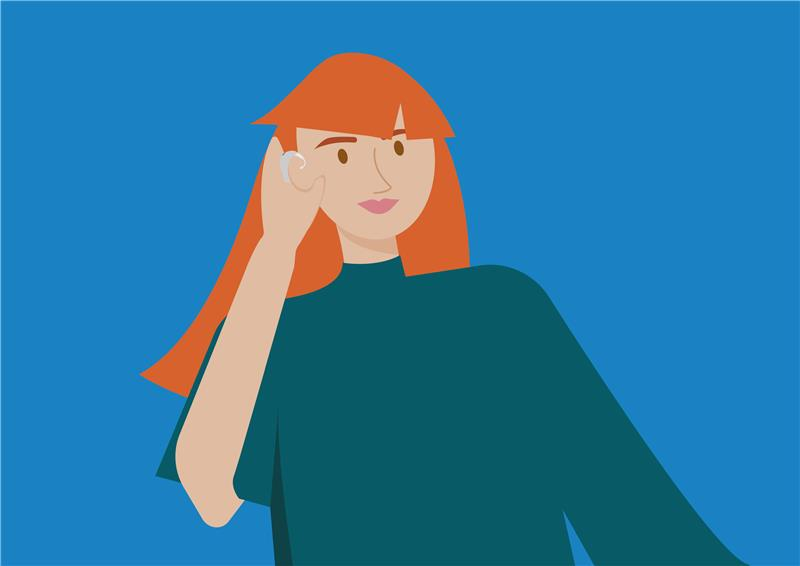
Explain that today’s discreet hearing aids resemble trendy headphones — modern devices are slim and stylish, making them more appealing than ever.
Use downloadable resources.

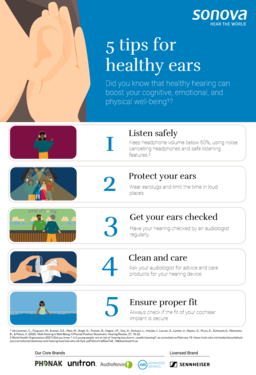
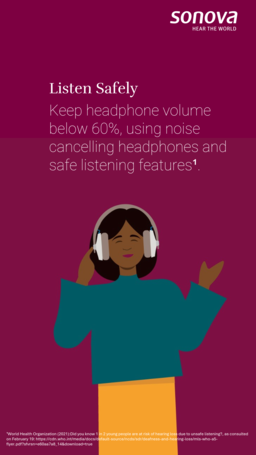

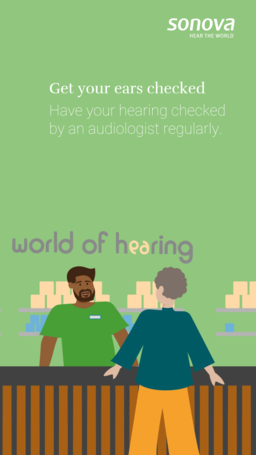
Find innovative hearing health solutions
While many people associate hearing health primarily with understanding speech and participating in conversations[7], it’s crucial for communication and emotional well-being.
At Sonova, we lead the way in hearing technology, introducing innovations like Bluetooth connectivity and AI-driven fittings. Our latest device, the Phonak Audéo™ Sphere Infinio, uses real-time AI to enhance speech understanding in challenging settings, allowing users to fully engage in conversations[8][9].
If you or someone you know is facing hearing challenges, explore these advanced solutions here. Take the first step here towards better hearing health today!
References:
[*]Vercammen, C., Ferguson, M., Kramer, S.E., Meis, M., Singh, G., Timmer, B., Gagné, J.-P., Goy., H., Hickson, L., Holube, I., Launer, S., Lemke, U., Naylor, G., Picou, E., Scherpiet, S., Weinstein, B., & Pelosi, A. (2020). Well-Hearing is Well-Being: A Phonak Position Statement. Hearing Review, 27, 18 -22.
[1] World Health Organization. (2021). World report on hearing. World Health Organization. https://apps.who.int/iris/handle/10665/339913. License: CC BY-NC-SA 3.0 IGO
[2] Holman, J. A., Drummond, A., Hughes, S. E., & Naylor, G. (2019). Hearing impairment and daily-life fatigue: a qualitative study. International Journal of Audiology. 58(7), 408–416. https://doi.org/10.1080/14992027.2019.1597284
[3] Agmon, M., Lavie, L., & Doumas, M. (2017a). The association between hearing loss, postural control, and mobility in older adults: A systematic review. Journal of the American Academy of Audiology, 28(6), 575-588. doi:10.3766/jaaa.16044
[4] Shukla, A., Harper, M., Pedersen, E., Goman, A., Suen, J. J., Price, C., … Reed, N. S. (2020). Hearing Loss, Loneliness, and Social Isolation: A Systematic Review. Otolaryngology–Head and Neck Surgery, 162(5), 622–633. https://doi.org/10.1177/0194599820910377.
[5] Nachtegaal, J., Festen, J. M., & Kramer, S. E. (2012). Hearing ability in working life and its relationship with sick leave and self-reported work productivity. Ear and hearing, 33(1), 94–103. https://doi.org/10.1097/AUD.0b013e318228033e
[6]Vercammen, C., Bott, A., & Saunders, G. H. (2021). Hearing health in the broader context of healthy living and well-being: changing the narrative. International Journal of Audiology, 60(sup2), 1-3. https://doi.org/10.1080/14992027.2021.1905893
[7]The World Health Organization (WHO). World Report on Hearing. 2021. Available at: https://www.who.int/publications/i/item/9789240020481. Last accessed: February 2025
[8]Real-time AI means that the AI DNN (Deep Neural Network) has been trained on sound samples to separate speech from background noise by processing the audio signal in real-time. This approach is fundamentally different from the use of AI for sound or acoustic scene classification, which is used in current hearing aids in the market. The real-time AI signal processing is performed by the DEEPSONIC™ chip, which is included in the Phonak Audéo Sphere Infinio platform together with the Phonak ERA™ chip.
[9]Wright, A., Seitz-Paquette, K., Kühnel, V., Latzel, M., Keller, M., Miller, A., Hobi, S., & Launer, S. (2024). Improving speech understanding and listening effort for complex environments with a novel noise reduction system [Scientific Poster]. Phonak Field Study News. https://www.phonak.com/evidence