
Why early hearing care can change a child’s future
Childhood hearing loss frequently begins subtly, and children often compensate in ways that make early signs easy to overlook. Globally, around 90 million children aged 5–19 live with hearing loss, and the WHO estimates that more than 60% of pediatric hearing loss cases are preventable through public health measures such as safe listening practices and timely treatment of ear conditions.¹ When unidentified or untreated, childhood hearing loss can interfere with speech, language, cognitive growth, and social development, often resulting in poorer educational outcomes and quality of life²,³.The World Hearing Day 2026 theme — “From communities to classrooms: hearing care for all children” — emphasizes community-based prevention and early identification efforts designed to ensure no child is left behind¹.
Awareness grows when we work together
When families, healthcare professionals, and community partners all stay alert to children’s listening needs, awareness grows — and with it, the chance to support kids earlier and more confidently. Awareness helps us notice small changes, ask gentle questions, and create environments where every child feels included and understood.
That’s why World Hearing Day 2026 highlights the importance of mobilizing the whole ecosystem. The featured film Don’t Let Hearing Loss Limit You! shows what listening challenges can feel like through the voices and experiences of children themselves — helping us see how understanding and support from others can truly open doors.
Watch the video stories of three children below which offer a powerful reminder of how understanding and support can shape a child’s journey:
-
Kyle
His positivity lights up every room. After losing his hearing during cancer treatment, he found strength and inspiration through the care around him — inspiring him to dream of becoming an audiologist himself.
-
Brooklynn
Brooklynn loves to talk, play, and explore language. With encouragement from her family and clearer listening moments, her confidence and communication continue to grow.
-
Percy
Percy’s first moments of hearing were filled with gentle discoveries — from reacting to a tap on the bathtub to noticing everyday sounds — showing how early support can open up a whole new world.
These stories remind us that awareness is a shared responsibility — and when communities collaborate, children can participate fully in every moment that matters.
Together, we can help protect children’s hearing early on
More than 60% of childhood hearing loss can be prevented through safe listening habits, prompt treatment of ear infections, and access to basic ear and hearing care services¹.
Encourage easy listening habits—like keeping volumes low and taking regular breaks from loud sounds—to help protect children’s hearing as they grow. You can also limit time in noisy environments, and make sure ear infections or ear pain are checked early by a healthcare professional, since untreated ear problems can affect children’s speech, language, and overall development⁴.
Prevention tips for families4
Keep device volumes within safe listening levels to reduce risk of noiseinduced hearing loss.
Seek medical care promptly for ear pain, infections, or drainage.
Encourage listening breaks and quiet time throughout the day.
Model safe listening habits; children follow adult behavior.

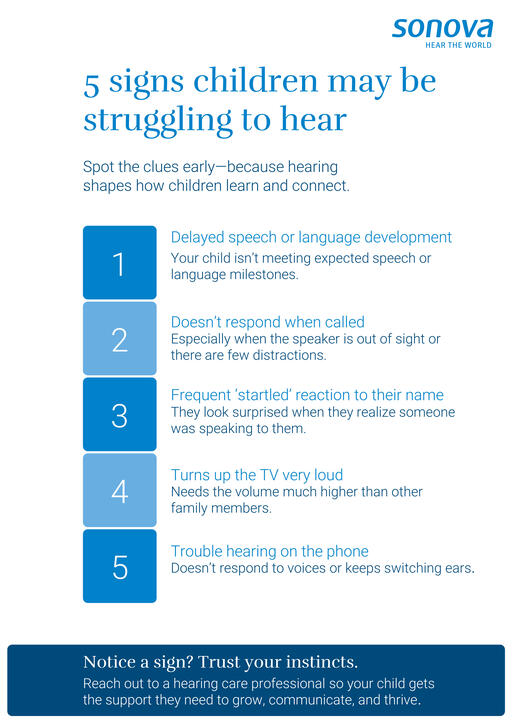
5 signs to look for if you’re wondering about a child’s hearing
Spotting these clues early can make a big difference in how children learn, communicate, and feel connected to the world around them³,⁵,⁶.
When something doesn’t seem quite right, trust your instincts—caregivers often notice the first hints that a child may need support⁷.
Below are five simple signs that may suggest it’s time to check in with a healthcare or hearing care professional⁸.
Could this be helpful to someone you know?
You can explore these signs in more detail through a helpful article and interview with a pediatric audiologist on the Phonak Audiology Blog: Everyday signs a child may benefit from a hearing evaluation | Audiology Blog
Download the “5 signs children my struggle to hear ” infographic
5 ways to support young listeners
After learning about the signs to watch for, it’s reassuring to know that there are also simple everyday things everyone can do to make listening easier for children. Small changes at home or in the community can help young listeners feel more included and better able to follow what’s happening around them.
Could this be helpful to someone you know?
Download the “5 ways to support young listeners” infographic

References:
World Health Organization. (2026). World Hearing Day 2026: From communities to classrooms: hearing care for all children. https://www.who.int/campaigns/world-hearing-day/2026
Lieu, J. E. C., Kenna, M., Anne, S., & Davidson, L. (2020). Hearing loss in children: A review. JAMA, 324(21), 2195–2205. https://doi.org/10.1001/jama.2020.17647
Roland, L., Fischer, C., Tran, K., Rachakonda, T., Kallogjeri, D., & Lieu, J. E. C. (2016). Quality of life in children with hearing impairment. Otolaryngology–Head and Neck Surgery, 155(2), 208–219. https://doi.org/10.1177/0194599816640485
World Health Organization. (2022). Be he@lthy, be mobile: a handbook on how to implement mSafeListening. Geneva: World Health Organization and International Telecommunication Union, 2022. Licence: CC BY-NC-SA 3.0 IGO.
McPhillips, H. A. (2010). Early identification and treatment may improve language development. The Journal of Pediatrics, 157(1), 170–171. https://doi.org/10.1016/j.jpeds.2010.05.008
Kunnathchalil, L., & Naomi, G. V. (2024). Early detection and intervention in childhood hearing loss. African Journal of Biomedical Research, 27(5s), 364–369. https://doi.org/10.53555/AJBR.v27i5S.5602
Emanuel, R., & Herman, R. (2020). The early identification of hearing loss and language effects. Springer Nature.
Phonak Blog (2026). Everyday signs a child may benefit from a hearing evaluation. https://audiologyblog.phonakpro.com/everyday-signs-a-child-may-benefit-from-a-hearing-evaluation/